
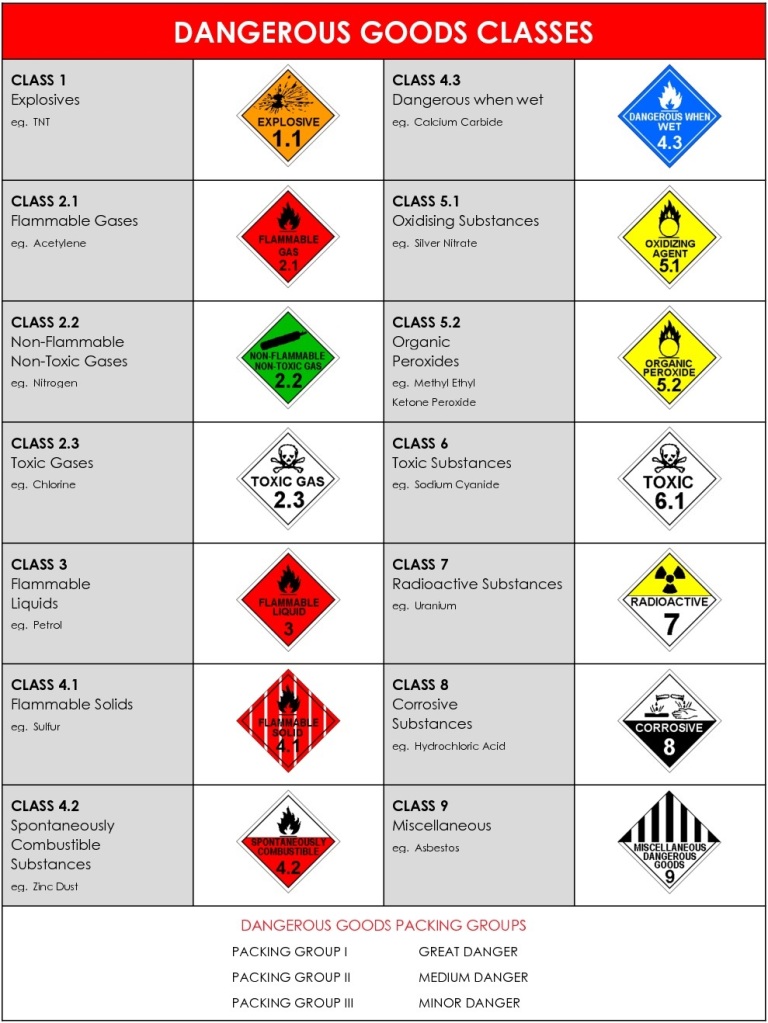
Classes of dangerous cargo are:
Class 1: Explosives
Division 1.1: substances and articles which have a mass explosion hazard
Division 1.2: substances and articles which have a projection hazard but not a mass explosion hazard
Division 1.3: substances and articles which have a fire hazard and either a minor blast hazard or a minor projection hazard or both, but not a mass explosion hazard
Division 1.4: substances and articles which present no significant hazard
Division 1.5: very insensitive substances which have a mass explosion hazard
Division 1.6: extremely insensitive articles which do not have a mass explosion hazard.
Class 2: Gases
Class 2.1: flammable gases
Class 2.2: non-flammable, non-toxic gases
Class 2.3: toxic gases
Class 3: Flammable liquids
Class 4: Flammable solids; substances liable to spontaneous combustion; substances which, in contact with water, emit flammable gases
Class 4.1: flammable solids, self-reactive substances and solid desensitized explosives
Class 4.2: substances liable to spontaneous combustion
Class 4.3: substances which, in contact with water, emit flammable gases.
Class 5: Oxidizing substances and organic peroxides
Class 5.1: oxidizing substances
Class 5.2: organic peroxides
Class 6: Toxic and infectious substances
Class 6.1: toxic substances
Class 6.2: infectious substances
Class 7: Radioactive material
Class 8: Corrosive substances
Class 9: Miscellaneous dangerous substances and articles
The numerical order of the classes and divisions is not that of the degree of danger
Class 10: Marine pollutants
Marine pollutants shall be classified in accordance with chapter 2.9.3 in IMDG Code.
Note :-
The IMDG code is a very much living document and gets amended from time to time (every 2 years). In the last decade major changes were made to Ems-emergency medical schedule, MFAG and INF codes (carriage of nuclear materials)
IMDG Code means the International Maritime Dangerous Goods (IMDG) Code adopted by the Maritime Safety Committee of the Organization by resolution MSC.122(75)
The objective of the IMDG Code is to enhance the safe carriage of dangerous goods while facilitating the free unrestricted movement of such goods and prevent pollution to the environment
INTERNATIONAL MARITIME DANGEROUS GOODS CODE:
- It gives a uniform international code of dangerous goods for transportation by sea
- It gives methods of packing in packets or in container, stowage and segregation of incompatible substances.
Legal status of IMDG code
- The IMDG code is a legal document under chapter VII part a of SOLAS 1974 as amended.
- Regulation VII/1.3 prohibits the carriage of dangerous goods by sea except when carried in accordance with the IMDG code.
- MARPOL 73/78, annex III, regulation 1(2) prohibits the carriage of harmful substances in ships except when carried in accordance with the IMDG code.
Application and implementation of IMDG Code
The provisions contained in this Code are applicable to all ships to which the International Convention for the Safety of Life at Sea, 1974 (SOLAS 74), as amended, applies and which are carrying dangerous goods as defined in regulation 1 of part A of chapter VII of that Convention.
The provisions of regulation II-2/19 of that Convention apply to passenger ships and to cargo ships constructed on or after 1 July 2002. For:
- A passenger ship constructed on or after 1 September 1984 but before 1 July 2002; or
- A cargo ship of 500 gross tons or over constructed on or after 1 September 1984 but before 1 July 2002; or
- A cargo ship of less than 500 gross tons constructed on or after 1 February 1992 but before 1 July 2002,
- For cargo ships of less than 500 gross tons constructed on or after 1 September 1984 and before 1 February 1992, it is recommended that Contracting Governments extend such application to these cargo ships as far as possible.
- All ships, irrespective of type and size, carrying substances, material or articles identified in this Code as marine pollutants are subject to the provisions of this Code.



There is no class 10.
Please correct this.