

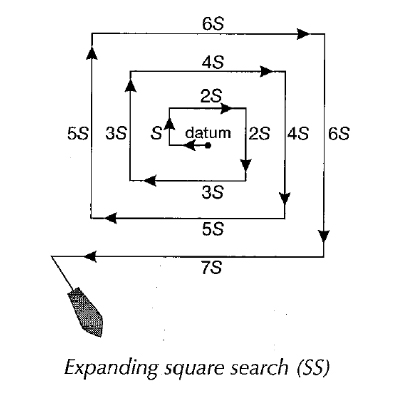
Different search patterns:
EXPANDING SQUARE SEARCH
- Most effective when the location of the search object is known within relatively close limits.
- The commence search point is always the datum position.
- Often appropriate for vessels or small boats to use when searching for persons in the water or other search objects with little or no leeway.
- Due to the small area involved, this procedure must not be used simultaneously by multiple aircraft at similar altitudes or by multiple vessels.
- Accurate navigation is required; the first leg is usually oriented directly into the wind to minimize navigational errors.
- It is difficult for fixed-wing aircraft to fly legs close to datum if 5 is less than 2 NM.
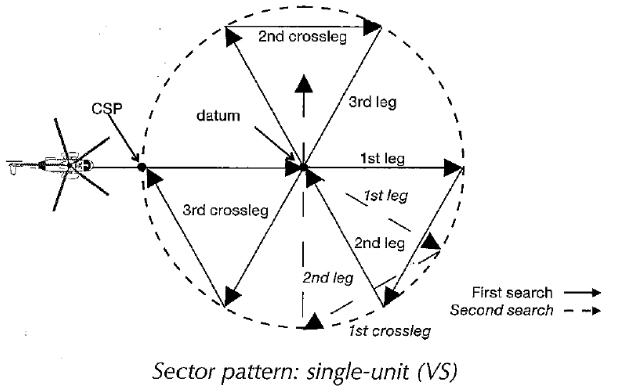
SECTOR SEARCH (V5)
- Most effective when the position of the search object is accurately known and the search area is small.
- Used to search a circular area centred on a datum point.
- Due to the small area involved, this procedure must not be used simultaneously by multiple aircraft at similar altitudes or by multiple vessels.
- An aircraft and a vessel may be used together to perform independent sector searches of the same area.
- A suitable marker (for example, a smoke float or a radio beacon) may be dropped at the datum position and used as a reference or navigational aid marking the centre of the pattern.
- For aircraft, the search pattern radius is usually between 5 NM and 20 NM.
- For vessels, the search pattern radius is usually between 2 NM and 5 NM, and each turn is 120˚, normally turned to starboard.
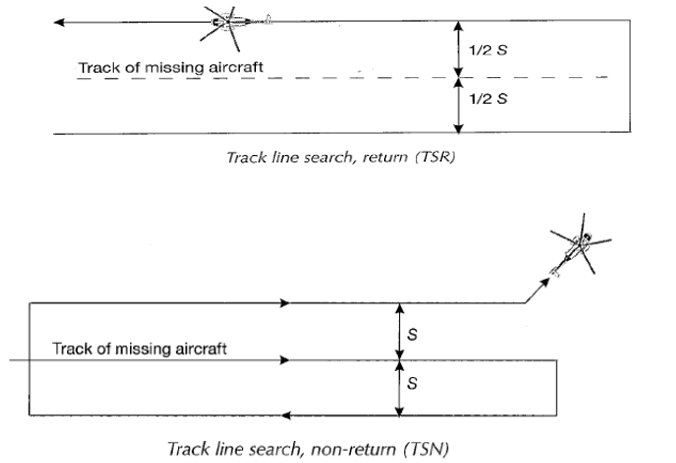
TRACK LINE SEARCH (TS)
- Normally used when an aircraft or vessel has disappeared without a trace along a known route.
- Often used as initial search effort due to ease of planning and implementation.
- Consists of a rapid and reasonably thorough search along intended route of the distressed craft.
- Search may be along one side of the track line and return in the opposite direction on the other side (TSR).
- Search may be along the intended track and once on each side, then search facility continues on its way and does not return (TSN).
- Aircraft are frequently used for TS due to their high speed.
Aircraft search height usually 300 m to 600 m (1,000 ft to 3,000 ft) during daylight or 600 m to 900 m (2,000 ft to 3,000 ft) at night.
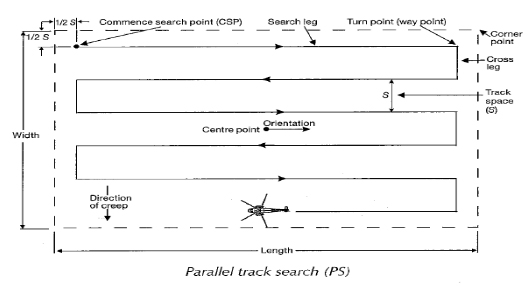
PARALLEL TRACK SEARCH (PS)
- Used to search a large area when survivor location is uncertain.
- Most effective over water or flat terrain.
- Usually used when a large search area must be divided into sub-areas for assignment to individual search facilities on-scene at the same time.
- The commence search point is in one corner of the sub-area, one-half track space inside the rectangle from each of the two sides forming the corner.
- Search legs are parallel to each other and to the long sides of the sub-area.
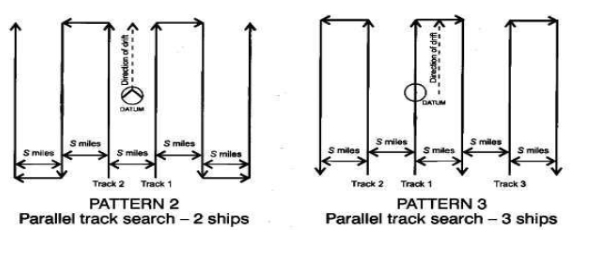
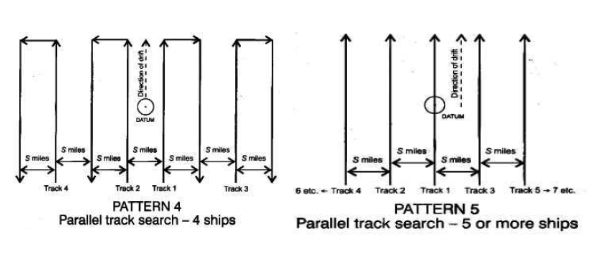
Multiple vessels may be used as shown:
- Parallel track search: for use by two ships.
- Parallel track search: for use by three ships.
- Parallel track search: for use by four ships.
- Parallel track search: for use by five or more ships.
CONTOUR SEARCH (OS)
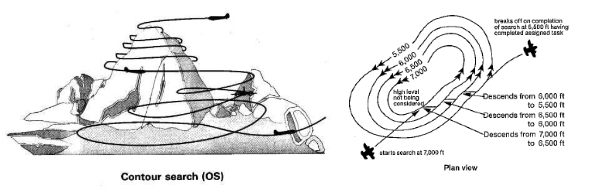
- Used around mountains and in valleys when sharp changes in elevation make other patterns not practical.
- Search is started from highest peak and goes from top to bottom with new search altitude for each circuit.
- Search altitude intervals may be 150 m to 300 m (500 ft to 1,000 ft).
- The aircraft may make a descending orbit away from the mountain before resuming the contour search at the lower altitude.
- The aircraft may spiral downwards around the mountain at a low but approximately constant rate of descent when there is not enough room to make a circuit opposite to the direction of search.
- If the mountain cannot be circled, successive sweeps at the same altitude intervals as listed above should be flown along its side.
- Valleys are searched in circles, moving the centre of the circuit one track spacing after each completed circuit.
CO-ORDINATED VESSEL-AIRCRAFT SEARCH PATTERN
- Normally used only if there is an OSC present to give direction to and provide communications with the participating craft.
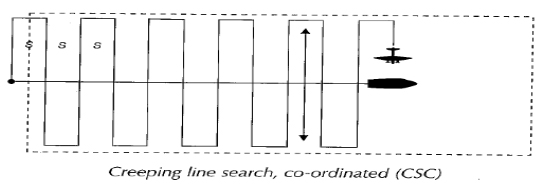
- Creeping line search, co-ordinated (CSC) is often used.
- The aircraft does most of the searching, while the ship steams along a course at a speed as directed by the OSC so that the aircraft can use it as a navigational checkpoint.
- The aircraft, as it passes over the ship, can easily make corrections to stay on the track of its search pattern.
- Gives a higher probability of detection than can normally be attained by an aircraft searching alone.
- Ship speed varies according to the speed of the aircraft and the size of the pattern. The relationship among the speed of the surface facility, the aircraft’s speed, the track spacing and the length of the search legs is defined by the following equation:
Vs = (5 x Va)/ (L + 5)
Where,
Vs is the speed of the surface facility in knots;
S is the track spacing in nautical miles;
Va is the aircraft’s true air speed (TAS) in knots, and
L is the length of the aircraft’s search leg in nautical miles.



What is “S” stands for in expanding square search
Which search to be carried out if time elapsed of 4 hrs. Thanks and best rgds
I’m a mariner ,my English is not strong . Please explain navigation in Hindi too.Your effort will help north indian mariners to help navigation easily.
Thanks in advance
i can explain in hindi please do call me on 7000722606
you are just too good. this is a welcome development.
your site is helping Mariners all over the world.
thanks
How is the initial distance between legs determined in an expanding square search?