
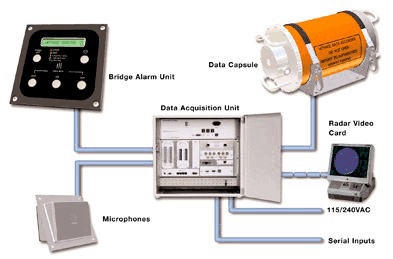
Simplified Voyage Data Recorder (S-VDR), as defined by the requirements of IMO Performance Standard MSC.163(78), is a lower cost simplified version VDR for small ships with only basic ship’s data recorded. It is not required to store the same level of detailed data as a standard VDR, but nonetheless should maintain a store, in a secure and retrievable form, of information concerning the position, movement, physical status, command and control of a vessel over the period leading up to and following an incident.
Hence, the principle difference between VDR and S-VDR lays in the requirements for recording of additional data
COMPARISON BETWEEN VDR & S-VDR RECORDING DATA
| Input | VDR | S-VDR |
| Date and Time | X | X |
| Ship’s Position | X | X |
| Speed | X | X |
| Heading | X | X |
| Bridge Audio | X | X |
| Communications Audio | X | X |
| Radar Data | X | X |
| AIS – (Radar alternative) | When no radar signal is available | |
| Acceleration and Hull Stresses (if fitted) | X | Only when they are available on the bridge via an IEC 61162 interface |
| Echo Sounder | X | |
| Engine Order and Response | X | |
| Hull Openings (Doors) Status | X | |
| Main Alarms (IMO Mandatory Bridge Alarms) | X | |
| Rudder Order and Response | X | |
| Watertight and Fire Doors Status | X | |
| Wind Speed and Direction | X |

Leave a Comment