
The term “scantling” refers to the determination of geometrical dimensions (such as wall-thickness and sectional modules) for a structural component/system. The initial scantling design is one of the most important and challenging tasks throughout the process of structural design.
Initial Scantling Criteria for Longitudinal Strength
In order to assess the structural strength of the ship, the minimum basic scantlings, which depend on the expected loads, must be determined. The load effects acting on a ship may be categorized as primary and secondary stresses. The primary stresses, also termed hull girder stresses, refer to the global response induced by hull girder bending. In contrast, the secondary stresses are termed local stresses and refer to the local response caused by local pressure or concentrated loads. The design rules require that the combined effect of primary and secondary stresses of structural members fall below the allowable strength limits of various failure modes.
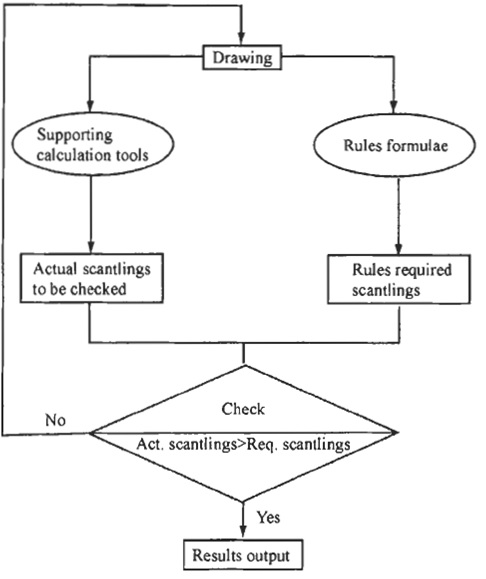
Fig : Data Flow in the Procedure of Structural Scantling
Initial Scantling Criteria for Transverse Strength
Ship hull is subjected to static and dynamic hydrostatic pressure in its bottom and two sides, and under loads due to weight of the cargo inside the hull as shown in figure. The transverse loads may cause cross-sectional deformation as shown in dotted lines, and stresses in transverse bulkheads, floors, side frames and deck beams. In general, hulls of the cargo ships are based on transverse system where the transverse strength may be modeled as two-dimensional frames. The two-dimensional frame is subjected to the hydrostatic pressure and loads due to cargo weight as shown in Figure below , as well as the shear forces transferred from thelongitudinal members.
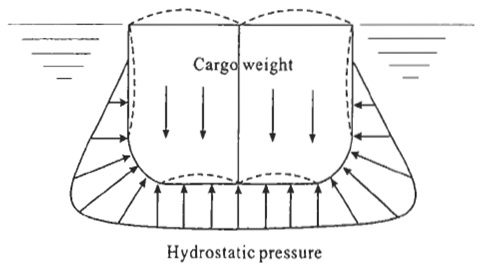
Fig: Transverse Loads on Ship Hulls
Initial Scantling Criteria for Local Strength
The local strength of primary and secondary structural members is evaluated by means of stresses due to local loads, such as lateral pressure or concentrated loads etc. Again, the elementary Bernoulli-Euler beam theory is utilized when computing the stresses or deflections for stiffeners and girders. Plate theory is used for plates. The derivation of the equations for stress and deflection, using the same assumptions as for elementary beam theory or plate theory.

Leave a Comment