
The strength of bulk materials increases with the addition of moisture and reaches a peak at some point beyond which additional moisture reduces the bulk strength. This point at which maximum strength is achieved can be determined in a Jenike style shear testing machine to enable design for worst case conditions.
Penetration test:
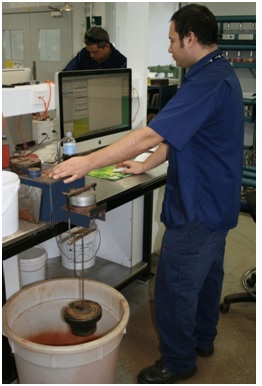
The basic idea of the Penetration Method has its origin in this phenomenon. A test sample in a cylindrical vessel is subjected to vertical vibration of acceleration X in 50/60 Hz exerted thereon. To judge liquefaction, a penetration bit of P gf/cm2 as the weight is placed on the surface of the sample. When the penetration depth of the bit exceeds a criterion D mm for T minutes, it is judged that the liquefaction occurred. Otherwise, the moisture content of the sample is less than the FMP.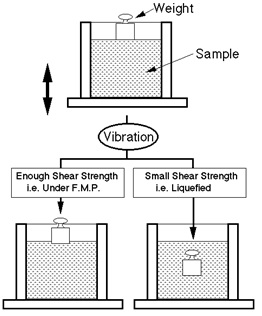
Low Consolidation Testing:
Flow properties tests are performed using a nike style shear testing machine. These tests the bulk strength and internal friction angles as functions of major consolidation stress for the bulk material, which allows calculation of storage facility design parameters. The consolidation stresses acting in a correctly designed hopper under flow conditions are relatively low. MAasurements of material properties at low consolidation pressures, including determination of compressibility (bulk density as a function of major consolidation pressures) and wall friction, allows calculation of design parameters to define the basic geometry of mass flow hoppers. Variable hopper geometry design charts will provide the necessary information to relate hopper half angles with critical arching dimensions and anticipated flow rates for both a conical and plane flow hopper design.
High Consolidation Testing:
When designing gravity reclaim stockpiles or large funnel flow storage bins, higher consolidation pressures need to be considered. Measurement of the bulk strength at high consolidation stresses allows calculation of draw-down angles and critical rathole dimensions for use in stockpile, expanded flow and reclaim bin design.
Testing with undisturbed Storage Time:
Many bulk materials gain cohesive strength when left undisturbed for a period of time, in particular in the presence of inter-particle moisture and clay. In those situations, time consolidation test work should be carried out to determine the amount of strength gained after undisturbed storage to allow design parameters to be calculated for these conditions. This test work is required in order to correctly design any hopper underneath a bin or stockpile, where the bulk material may sit at rest for a period in excess of three hours. The time consolidation behaviour of a bulk solid also influences the ratholing characteristics in large funnel-flow silos and gravity reclaim stockpiles.
Testing with vibrated Storage Time:
Many bulk materials gain cohesive strength when vibrated for a period of time, in particular in the presence of inter-particle moisture and clay. In those situations, vibrated storage tests should be carried out to determine the amount of strength gained after vibration to allow design parameters to be calculated for these conditions. This is of importance for belly-dump rail car designs to determine the minimum outlet dimensions to prevent bridging.
Wall Friction Testing:
Frictional measurements between wear liners and the bulk material provide the design basis for transfer chutes and hoppers. From wall friction charts, minimum chute and valley angles may be calculated as a function of the material bed depth. Adhesion and wall friction on large (lump) materials can also be measured in an inverted style wall friction tester. This is useful in selecting wall materials that may exhibit the least amount of hang-up in static conditions such as reclaimer buckets, truck trays or dribble chutes.
Particle Size Distribution Analysis:
A full particle size analysis can be performed in a standard dry-sieve tower or using a Malvern Mastersizer wet laser particle analyser for very fine materials such as concentrates.
Static Angle of Repose:
The natural rill angle (angle of repose) of a bulk material sample can be determined for fines and coarse materials.
Dynamic Impact Adhesion & Build-Up:
At higher velocities, impacting material streams onto wall surfaces can lead to build-up over time. This test work is aimed at measuring and observing any build-up effects on a wall surface on which material impacts at a pre-set inclination angle and impact velocity. Performing this test work at one range of wall materials and bulk moisture contents helps in selecting an appropriate wall surface for the desired application.
Chute Drop Test:
The knowledge of the way in which a bulk material flows down through a vertical chute into a vessel such as a railway wagon is of importance when there is a potential for flooding due to aeration. A chute drop test is available which allows to compare materials relative to each other.