
Timber Load Lines
Special timber load lines can be used only when a ship carrying a cargo of timber on deck complies with the Load Line Rules. For the carriage of timber as deck cargo, the IMO “Code of Practice for Timber Deck Cargoes” must be followed.
The practical applications
The provisions contained in the IMO Code are recommended for all vessels of 24m or more in length engaged in the carriage of ‘timber deck cargoes’ – a phrase defined as meaning a timber cargo carried on an uncovered part of a freeboard or superstructure deck, and includes logs and sawn timber whether loose or packaged. Basically, the following factors need to be considered:
- Type and compactness of timber cargo. Example: logs, cants, ragged end packages, square (or flush) both ends, etc.
- Type of vessel – timber load line or not.
- Strength, pitch and tending of lashings.
- Height of cargo and stability considerations.
- Measures to deliberately jettison cargo.
- Keeping clear all sounding and air pipes necessary for the working of the ship, ensuring means of safe access to all parts of the ship, keeping cargo hold ventilators clear for operation.
- ‘Under-deck’ and ‘on-deck’ bills of lading.
- Hatchcovers and other openings below decks should be securely closed and battened down.
- Hatches and decks, and the cargo itself, should be kept free of any accumulations of ice and snow.
- All deck lashings, uprights, etc, in position before loading commences.
- The cargo must not interfere in any way with the navigation or necessary working of the ship.
During the winter season the height of the timber deck cargo above the weather deck may not exceed one third of the extreme breadth of the ship. At other times the regulations do not prescribe any limit. The deck load may be built up to any height, consistent, of course, with the general requirements of safety and stability, and must not exceed the designed maximum permissible load on the weather decks and hatches.
The height of the deck cargo should be restricted so that the visibility from the navigation bridge is not impaired and any forward facing profile of the timber cargo on deck does not present overhanging shoulders to a head sea.
Ship’s personnel must also be protected and, if timber cargo is carried on deck, guard rails or guard lines must be provided on each side of the deck cargo, together with a lifeline to allow the crew to move along the surface of the timber over the length of the ship. The IMO “Code of Safe Practice for Ships Carrying Timber Deck Cargoes” contains many more guidelines, all aimed at overall safety.
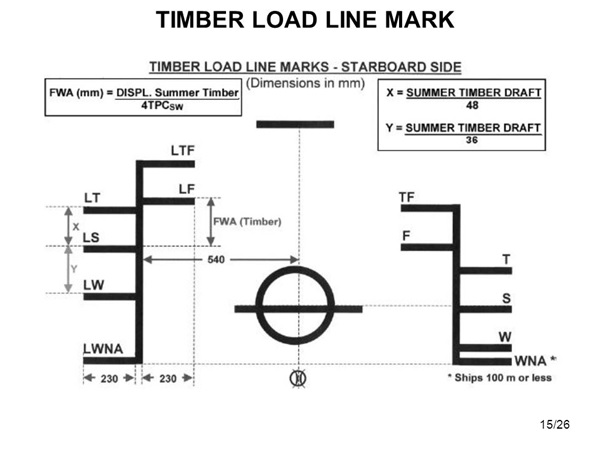
The special timber load lines are marked on the ship’s sides as follows (the “L” standing for “lumber”, another word for wood):
LS = The Summer Timber Load Line indicated by the upper edge of a line.
LW = Winter Timber Load Line.
LWNA = The Winter North Atlantic Timber Load Line. This is level with the WNA Line.
LT = The Tropical Timber Load Line.
LF = The Fresh Water Timber Load Line in Summer.
LTF = The Fresh Water Timber Load Line in the Tropical Zone.
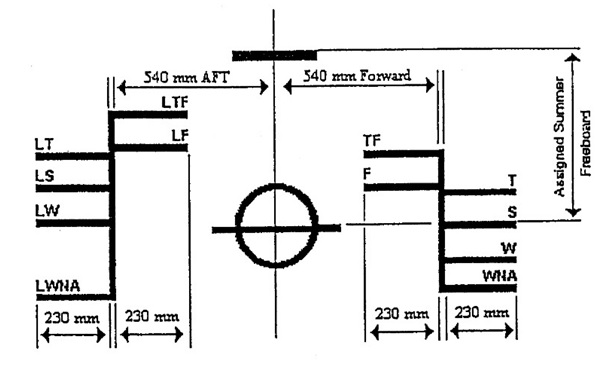 In all cases the freeboard is indicated by the vertical distance from the upper edge of the deck line to the upper edge of the load line in question.
The lumber freeboard is less than the normal summer freeboard to indicate that the timber may add to the ship’s superstructure volume and thus improve the reserve buoyancy.




Why do timber ships have different load line markings compared to other ships like container ships, bulk carriers, etc.?