
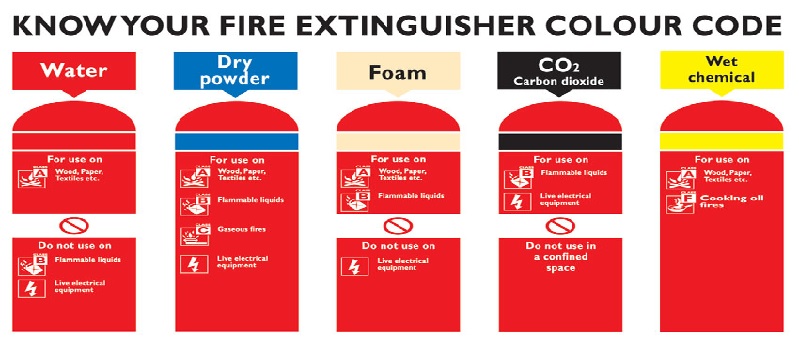
Types of foam available for marine use:
- Protein base ( PF)
- Flouro protein foam (FP)
- Film forming fluoro protein foam (FFFP)
- Synthetic detergent foam
- Alcohol resistant foam-chemical fires
- Aqueous film forming foam ( AFFF).
Note:
-
Water and Foam
Water and Foam fire extinguishers extinguish the fire by taking away the heat element of the fire triangle. Foam agents also separate the oxygen element from the other elements.
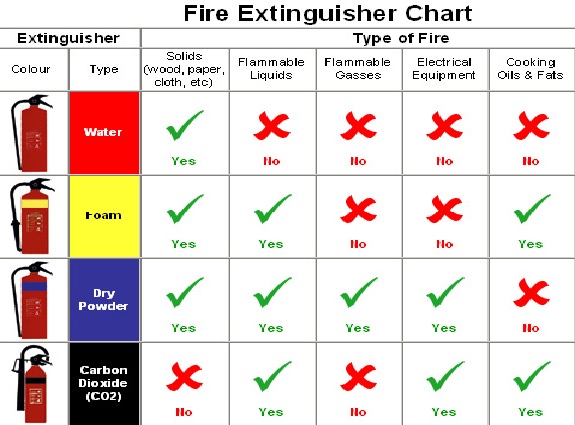
Water extinguishers are for Class A fires only – they should not be used on Class B or C fires. The discharge stream could spread the flammable liquid in a Class B fire or could create a shock hazard on a Class C fire.
-
Carbon Dioxide
Carbon Dioxide fire extinguishers extinguish fire by taking away the oxygen element of the fire triangle and also be removing the heat with a very cold discharge.
Carbon dioxide can be used on Class B & C fires. They are usually ineffective on Class A fires.
-
Dry Chemical
Dry Chemical fire extinguishers extinguish the fire primarily by interrupting the chemical reaction of the fire triangle.
Today’s most widely used type of fire extinguisher is the multipurpose dry chemical that is effective on Class A, B, and C fires. This agent also works by creating a barrier between the oxygen element and the fuel element on Class A fires.
Ordinary dry chemical is for Class B & C fires only. It is important to use the correct extinguisher for the type of fuel! Using the incorrect agent can allow the fire to re-ignite after apparently being extinguished succesfully.
Note:
The capacity of required portable fluid extinguishers should not exceed more than 13,5 litres but not less than 9 litres. Other extinguishers should be at least as portable as the 13,5 litre fluid extinguishers, and should have a fire-extinguishing capability at least equivalent to a 9 litre fluid extinguisher.
The following capacities may be taken as equivalents:
- 9 litre fluid extinguisher (water or foam).
- 5 kg dry powder.
- 5 kg carbon dioxide.

Leave a Comment