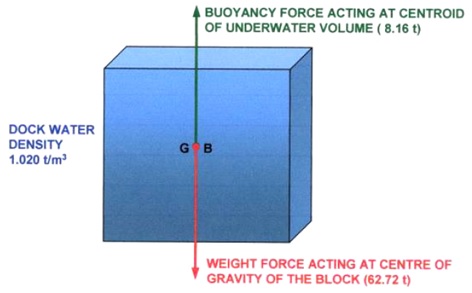
Archimedes’s principle states that when a body is wholly or partially immersed in a liquid, it experiences an upthrust (apparent loss of mass – termed Buoyancy force (Bf)), equal to the mass of liquid displaced.
Consider a block of steel measuring 2 m X 2 m X 2 m that has a density of 7.84 t/m3.
If the block were to be suspended by a ship’s crane that has a very accurate load gauge, what mass would register on the gauge if the block were suspended over the ship’s side in air?
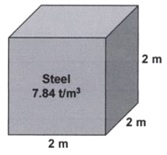
The block is suspended in air
Since: Mass = Volume × Density;
Mass of the block = (2m × 2m × 2m) × 7.84 t/m3 = 62.72 t
The crane driver now lowers the block so that it becomes half submerged in the dock water that has a density of 1.020 t/m3.
What mass will the gauge now indicate?
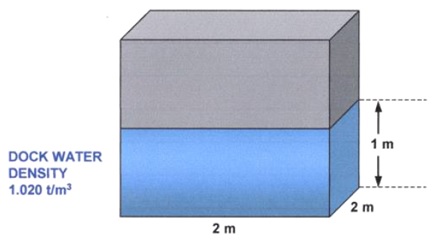
The block is now displacing a volume of water where:
Volume of water displaced = (2 m × 2 m × 1 m) = 4 m3
Mass of water displaced = Volume × Density of the dock water;
= 4 m3 × 1.020 t/m3
= 4.08 t which represents the upthrust due to Buoyancy force (Bf) created by the displaced water.
Mass of block 62.72 t
Upthrust due to Bf 4.08 t
Gauge reading 58.64 t
What mass will the gauge indicate if the crane driver now lowers the block so that it is completely submerged in the dock water?
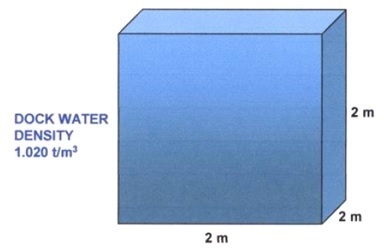
The block is now displacing a volume of water where:
Volume of water displaced = (2 m × 2 m × 2 m) = 8 m3
Mass of water displaced = Volume × Density of the dock water;
= 8 m3 × 1.020 t/m3
= 8.16 t which represents the upthrust of the buoyancy force (Bf) created by the displaced water.
Mass of block = 62.72 t
Upthrust due to Bf= 8.16 t
Gauge reading= 54.56 t