
The emergency wreck-marking buoy is designed to provide high visual and radio aid to navigation recognition. It should be placed as close to the wreck as possible, or in a pattern around the wreck, and within any other marks that may be subsequently deployed. The emergency wreck marking buoy should be maintained in position until:
- The wreck is well known and has been promulgated in nautical publications;
- The wreck has been fully surveyed and exact details such as position and least depth above the wreck are known;
- A permanent form of marking of the wreck has been carried out.
Emergency wreck marking buoy can be used to mark a newly discovered hazard not yet shown in nautical documents. It has blue and yellow vertical stripes in equal number, with a vertical/perpendicular yellow cross top-mark, and displays a blue and yellow alternating light.
The buoy has the following characteristics:
- A pillar or spar buoy, with size dependant on location.
- Coloured in equal number and dimensions of blue and yellow vertical stripes (minimum of 4 stripes and maximum of 8 stripes).
- Fitted with an alternating blue and yellow flashing light with a nominal range of 4 nautical miles where the blue and yellow 1 second flashes are alternated with an interval of 0.5 seconds.
- If multiple buoys are deployed then the lights should be synchronised.
- Consideration should be given to the use of a racon Morse code “D” and/or AIS transponder.
- The top mark, if fitted, is to be a standing/upright yellow cross.
- The light characteristic was chosen to eliminate confusion with blue lights to identify law enforcement, security and emergency services.
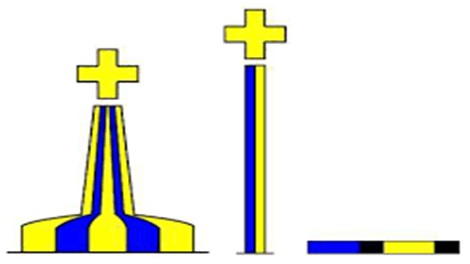
Fig : Emergency wreck marking buoy

Leave a Comment