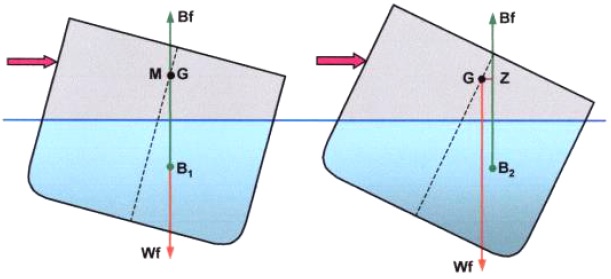
There are 3 conditions of stability of a ship:
- Stable Condition
- Unstable Condition
- Neutral Condition
STABLE CONDITION:
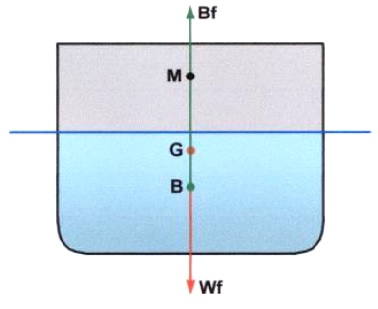
A ship is in a stable condition of stability if, when heeled by an external force in still water to a small angle of inclination, it returns to the upright when the force is removed.
Consider a ship that is floating upright in still water, with the positions of G and B as shown, where the initial transverse metacentre (M) is above G.
i.e. GM = KM – KG; which has a positive value.
The ship is now heeled by an external force to a small angle of inclination.
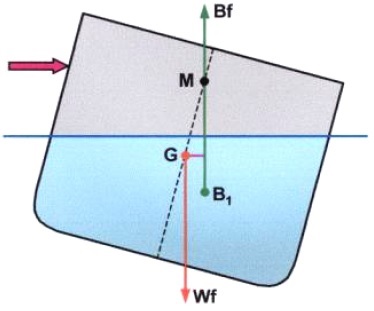
Consider the lines of action of weight force (Wf), acting downward from G, and buoyancy force (Bf), acting upwards from B1 through the initial transverse metacentre (M). The ship will want to return to the upright condition when the external force is removed.
In this stable condition the righting lever GZ is acting to upright the ship.
G is below M; initial GM is positive.
NEUTRAL CONDITION
A ship is in a neutral condition of stability if, when heeled by an external force in still water to a small angle of inclination, it comes to rest at an indeterminate angle of heel within small angles of inclination.
Consider a ship that is floating upright in still water with G and B as shown. The initial transverse metacentre (M) is at the same height as G.
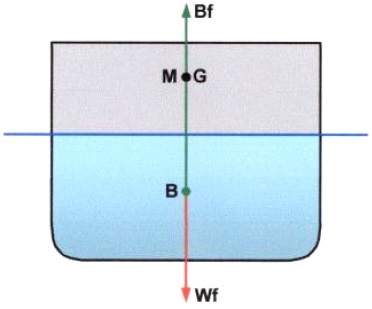
i.e. KM – KG = 0; GM = 0
The ship is now heeled by an external force to a small angle of inclination.
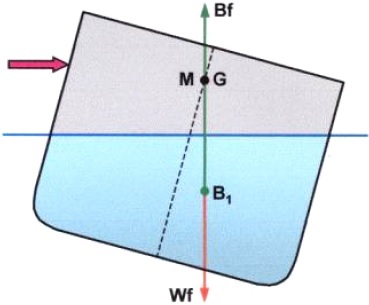
Since the ship has no GM, the lines of action of Wf and Bf remain in the same vertical; there is no horizontal separation between them when the ship is heeled within small angles of inclination. Thus, righting lever GZ will not exist.
In this neutral condition the righting lever GZ will not exist.
G is at the same height as M; the ship has zero GM.
The ship will settle at an indeterminate angle of heel within small angles when acted upon by successive external forces.
If the ship is heeled beyond small angles the centre of buoyancy (B) will move outboard of the centre of gravity (G). This causes a positive righting lever, GZ, to take effect to return the ship back to some indeterminate small angle of heel once the external force is removed.